 OurBigBook Docs
The
\H tag argument marks another header as a tag of the current header.Tags essentially allow you to classify a single header as a child of multiple headers, as opposed to its location in the header tree which is unique.
Internal links inside a header automatically tag that header with their targets, unless the target is already a structural ancestor of the header. Descendancy already provides that relationship. This includes links nested inside other macros, such as formatting, and links in the Here
\H title2 argument. For example:= Home
== Animal
== About \i[<Animal>]About Animal is tagged with Animal, so adding {tag=Animal} would be redundant. Both <Animal> and \x[animal] create implicit tags. Links in the section body and topic links do not.If
About Animal were a child or deeper descendant of Animal, the link would not create an implicit tag. This also applies to ancestors reached through includes.Repeated tags are errors, including explicit tags that duplicate these implicit tags.
Sample usage:
= Animal

== Mammal

=== Bat
{tag=Flying animal}

=== Cat

== Bird

=== Humming bird
{tag=Flying animal}

== Flying animal
So here we see that
Bat and Humming bird have their unique position in the tree under Mammal ane Bird. But we also wanted them to be somehow classified under Flying animal. Tags allow us to do that.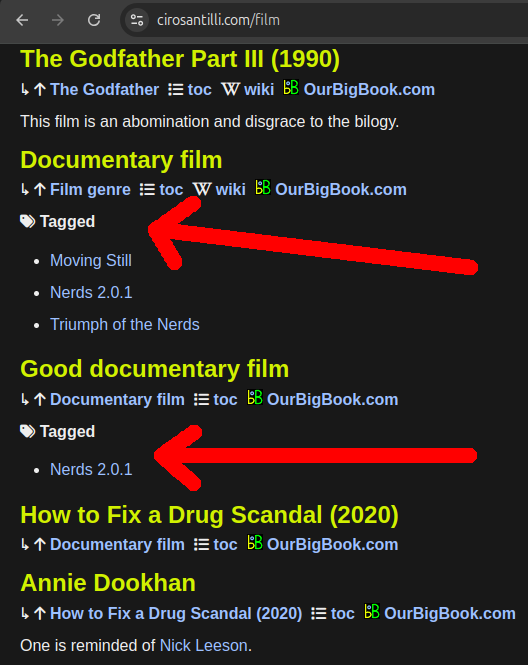
Non-toplevel tagged headers demo
. Visible live at: cirosantilli.com/film#documentary-film Details.
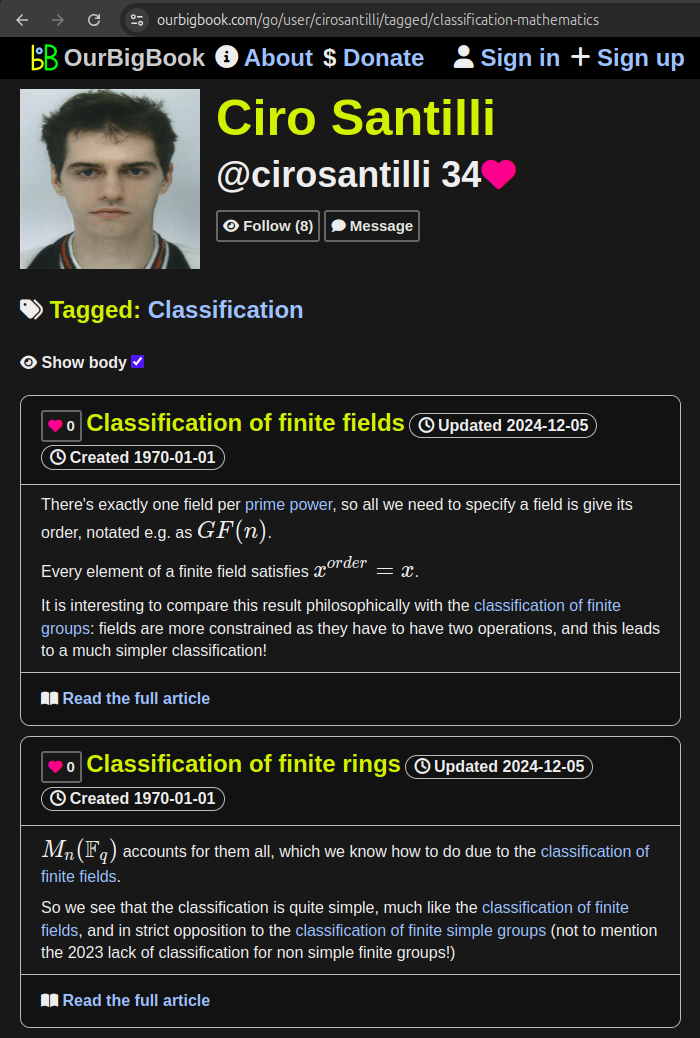
OurBigBook Web tagged article list with body demo
. On OurBigBook Web, you can also list all articles tagged by an article while also showing the tagged article bodies rather than just their titles. Live URL: ourbigbook.com/cirosantilli/classification-mathematics/-/tagged Details.